Conference )
World Wide Wind Conference
N46° 25' 45" E9° 45' 28"
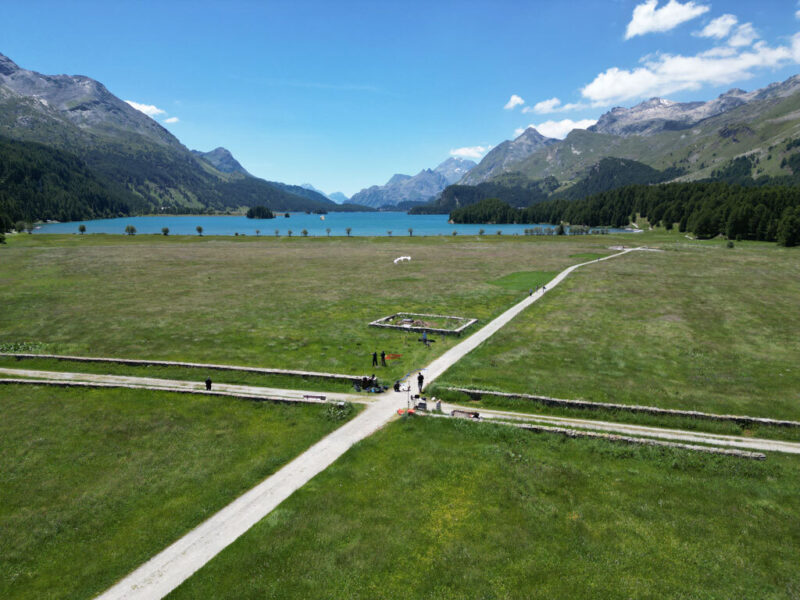
Nomadic, open air festival, gathering artists and scientists with backgrounds in music, soundart, philosophy, art and cultural history, sonification, science theory, telematics, transdisciplinarity.
03.07.2026, 12:00–12:15
Eva Pauline Bossow and Florian Dombois
Welcome and Introduction
×
03.07.2026, 12:15–12:45
Karin Harrasser
Planting Air. On Stories about the Wind and How Texts can Absorb Moisture
×
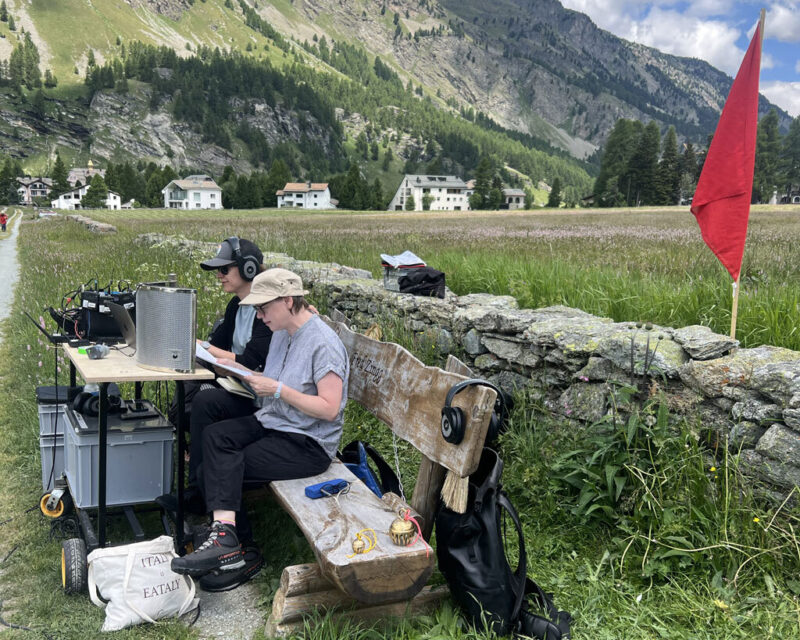
The talk develops the gesture of «planting air in texts» by experimenting with the metaphorology of the wind, its dynamics, patterns and unpredictability. It sounds out, how texts can open up for unfamiliar voices, for contingency and situatedness, for vulnerabillities and the deep history of political change. For this, it chooses Joris Ivens’ filmmaking as a dialogue-partner and travels to Guatemala to find out how kite-flying and mourning can come together as aesthetic-political practices.
03.07.2026, 13:00–13:30
Ellen Røed
On the First Wednesday of Every Month
×
From within a public rehearsal with the Sound Kite Ensemble, this talk reflects on calibration as artistic practice by understanding triple instruments as choreographic objects enabling processes of social and material tuning. Tempering an openness to the instant, the kites rehearse how to fly, how to listen, how to be in the wind, in the world, together. Senses are aligned and brought into phase, tightening capacity for attention, and setting it adrift at the same time.

03.07.2026, 15:00–15:30
Hans-Jörg Rheinberger
What Is an Instrument? Some Reflections
×
My contribution is structured as follows: After a brief introduction describing the core-dialectics of experimentation and introducing the notion of epistemic things as research targets, I have a look at the role of instruments in the research process. Then, I ask whether instruments themselves can become objects of epistemic interest. The third and final part revolves around what I call musical things as a category distinguishable from scientific instruments and epistemic things, as aesthetic entities of their own dignity.

03.07.2026, 16:00–16:30
Michael Hagner
The Sound of Sils
×

03.07.2026, 17:45–18:00
Olivier Chazot
Research Expedition to the Wind (Introduction)
×
This talk explores the boundary between mathematical reconstruction and the raw reality of natural phenomena.

03.07.2026, 17:30–18:00
Cathy van Eck
Windfahne 1
×
After attending many rehearsals in Sils Maria I put several of the recordings in cardboard boxes, playing them through transducers. I wrote the date of each recording on top of each box and made the wind seeable through a big sheet of transparent plastic to make the wind “seeable”. I gave the boxes to the audience, so they could hold the traces of the rehearsals in their hands. The small box was vibrating according to the sound waves of our rehearsal and the audience could touch the box with their hands. As they touched the vibrating boxes, the sound changed.

03.07.2026, 18:00–18:45
Olivier Chazot
Research Expedition to the Wind
×
This talk explores the boundary between mathematical reconstruction and the raw reality of natural phenomena. It looks at the modern technical obsession with capturing and digitizing the wild world. It re-examines Galileo’s famous claim that nature is written in mathematical characters, showing that while geometric ideals exist in our minds, they act as an ideal stencil we try to place over living matter. Through the poetic reality of wind and fluid turbulence, it contrasts the rigid, algorithmic attempt to measure nature point by point, which we call an «épuisement technique» (technical exhaustion), with a more profound, qualitative exploration of space and form. Using images, the paper discusses the separation between abstract theories and sensory experience, and shows how numbers alone fail to let us pass from one realm to the other. Finally, drawing on the phenomenological philosophies of Husserl and Merleau-Ponty, it advocates for a transition from restrictive computational boxes to welcoming spaces of shelter (abri). By analyzing artworks that investigate architectural wind installation and the delicate, live equilibrium of a flying kite, it argues for a «science of the sign» over mere technical manipulation. The paper suggests that art offers a unique pathway to return to a shared space of open curiosity, teaching us what it truly means to listen to, collaborate with, and genuinely inhabit the World Wild Wind.

03.07.2026, 22:00–22:30
Michael Flury, Fabian Mösch, Martina Lussi
Windinstrument - Turbulence Study - Kite Songs
×
The compositions combine processed wind-kite-human recordings (Triple Instruments) with wind instruments and electronic interventions. Wind becomes not merely a musical impulse but a partner in improvised dialogue: culturally coded and uncoded sound systems meet as equals. Active listening becomes the precondition for musical action – a letting go of control that opens space for shifts in pressure, for pauses, patterns and microtonal behaviour. // Tracklist: Turbulence Study I (05:30) / Turbulence Study II (05:34) / Windinstrument (10:56) / Kite Song I (01:42) / Kite Song II (02:22) / Kite Song III (02:07) / Kite Song IV (00:51) // Total: 29:02

04.07.2026, 10:00–10:15
Eva Pauline Bossow and Florian Dombois
Welcome and Introduction (Day 2)
×

04.07.2026, 10:30–11:00
Helene Romakin
Being-in-the-World With, Through, and Along the Wind. With a song (Kite am Himmel) by Berit Seidel
×
Can we entangle with our environment with, through, and along the wind? How can we remain capable of acting in a world shaped by polycrisis? This contribution approaches human situatedness through the lens of the environmental humanities, exploring questions of citizen response-ability, non-intrusive modes of being-in-the-world, and non-extractivist forms of intra-action. It argues that process-driven, site-specific, and embodied encounters can foster new ways of thinking, relating, and engaging.
04.07.2026, 11:00–11:30
Inge Hinterwaldner
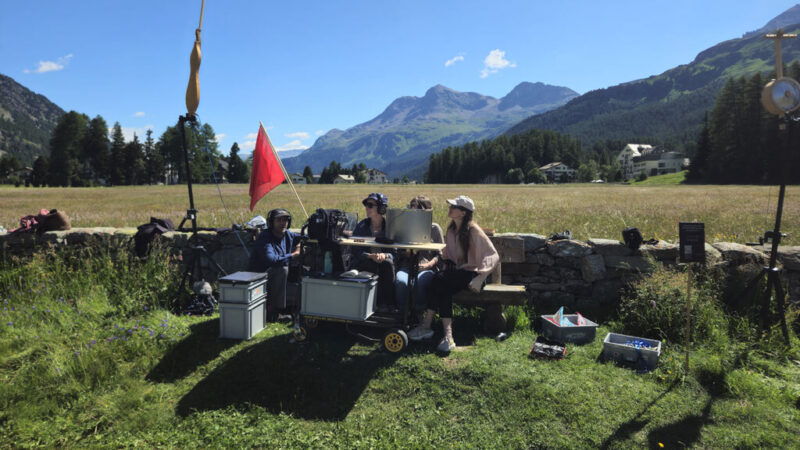
A Matter of Scale and Empathy. Crafting conceptual lines between sky and ground
×
In 1985, sky artist Steve Poleskie performed one of his most ambitious pieces at the 6th International Video Art Festival in Locarno. Piloting an aerobatic plane, he created drawings in the sky using enhanced exhaust fumes and complex flight maneuvers. He further envisioned a telematically enhanced, multi-sensory ‘expanded cinema’ that would immerse the audience below. What kites achieve naturally through their very design — connecting action in the sky with perception and action on the ground — constitutes one of Poleskie's central concerns and greatest challenges, since his art requires him to maintain distance from his audience. This contribution traces the artist's strategies, up and down, for establishing conceptual lines between the sky and the crowd on the ground.

04.07.2026, 12:00–12:30
Kaspar König
Cald-air. Unstable mobiles for airdrums
×
When Alexander Calder moved his delicate balances from the studio ceiling into the open air, he already suspected that the wind would become the true choreographer. In Cald-air, I take Calder’s principle one step further: the mobile is not suspended from a fixed point, but from the line of a sled kite, which stands "still" in the air like a floating sculpture. The kite becomes the sky-anchor. The line becomes the invisible spine. At the end of the mobile, bouncing balls strike upright drums, which are hit stochastically.

04.07.2026, 12:30–13:00
Katja Naie
Creating Democratic Spaces of Knowledge. Art, Science and the Practice of Shared Attention
×
In times when scientific expertise is increasingly challenged and competing truths shape public debate, the question is no longer only what we know, but how knowledge is negotiated. Drawing on curatorial practice, this talk proposes that art-and-science exhibitions are democratic knowledge spaces: places where scientific expertise, artistic imagination and lived experience encounter one another without immediately collapsing into fixed hierarchies. Their democratic value lies in creating the conditions for shared knowledge rather than shared opinions.

04.07.2026, 13:15–13:45
Patrick Müller
Transwaiting. Making latency in artistic research
×
Waiting is both constraint and possibility. We are subjected to it, yet it enables forms of attention that would otherwise remain unavailable. Moving from milliseconds of latency through infrastructural breakdowns and waiting for wind to the long temporalities of climate change, this talk develops the concepts of thin, thick, and feral waiting. Transwaiting describes their movement across temporal scales, showing how waiting can shift from ‘waiting for’ towards ‘waiting with’, revealing hidden relations and agencies and ultimately making time.
04.07.2026, 14:15–14:40
Isabel Mundry
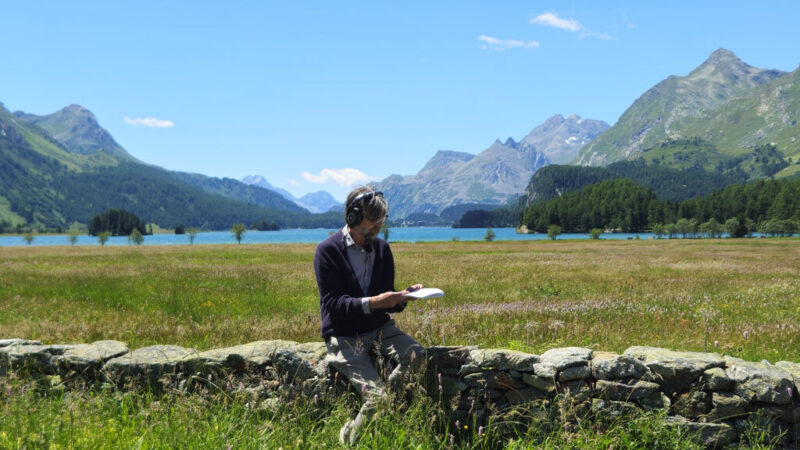
Songlines for Wind, Kites, Trombone and Florian
×
Interpreted by Kevin Toksöz Fairbairn and Florian Dombois

04.07.2026, 15:00–15:30
Todd Sekuler
The Absent Archive
×
Although I have never met them, my great-grandmother's nephew, Arthur Adler, introduced me to my great-great grandfather, Samuel Baum. This occurred through a newly discovered family heirloom: a 1.5-minute 8mm film depicting my Jewish great-great-grandfather in front of his home, shot in the 1930s in a former Jewish district in Tarnów, Poland. Arthur had been born and raised in the United States and brought his camera with him on a trip to Europe. In 1990, the material was transferred to VHS during which Arthur added an audio narration describing what he remembered of the world that unfolds through the images of the film. This presentation asks what can be known of the person behind the camera from a visual archive that excludes him from view—i.e. through the archive of materials I have been able to uncover revealing his work and kinship network, but also through the archival traces of his absent presence in the steadiness of the shot, the choices of framing, the act of diasporic return, the materiality of film, and the later voice that returns to explain the images—often in contradiction to the history of events made apparent through the historical archive available. Placing this family footage in relation to Jewish migration from Poland to the United States around the turn of the twentieth century, the presentation treats the cameraperson as a figure of absence in the visual archive, asking what the desire to access the one who looked might help for rethinking what an absent archive contains.

04.07.2026, 15:45–16:00
Eva Pauline Bossow and Florian Dombois
Closing
×

04.07.2026, 16:00–16:10
Michael Flury and Fabian Gutscher
Farewell: Conch Shell, Alphorn and participants ringing the bells
×
